
A coach is not built through theory alone. Coaching becomes credible when it is practiced, observed, reflected upon, and lived.
At Butterfly Coaching Academy, we believe in the power of inner transformation. Our name reflects our core focus: metamorphosis. Just like a caterpillar undergoes multiple stages of transformation to become a butterfly, we guide coaches through a learning journey that is developmental, human, and deeply practical.
Our coach education is created on the GOLD standards of ICF competencies, designed to help you grow into the “being” of a coach, not only the “doing.”
ICF credentials are globally respected because they require more than completing a course. They ask for education, practice hours, mentor coaching, performance evaluation, and an exam; a full pathway that supports credibility and ethical practice in real coaching work.
And yet, a credential is not the destination.
It’s a journey and not a destination. Credentials are important and one must become capable to earn the same. To become capable enough, one has to walk the path.
When we started developing our coach training program, we were challenged to produce results for our clients using coaching as a methodology. We did intensive research, tested strategies across clients, and arrived at a simple and powerful framework we call i.K.A.N.
i.K.A.N gives a strong structure to coaching conversations and helps coaches partner with clients in a way that creates sustainable action and meaningful results.
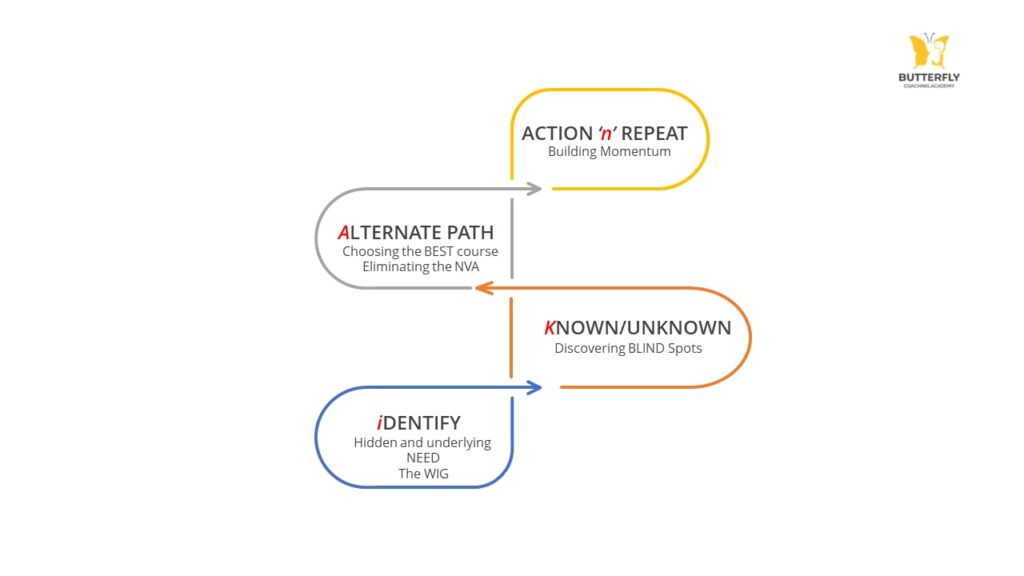
We slow down, create space, and uncover what truly matters. Not the noise, not the symptoms. The real need.
We help clients notice what is not yet visible; assumptions, patterns, inner conflicts, and the unspoken truths shaping their choices.
We explore options with clarity. We separate meaningful action from busy action, and choose what aligns with purpose.
We turn insight into practice. Repetition builds confidence, new identity, and sustainable change.
This philosophy is also how we shape coach education: not as information transfer, but as a journey of becoming.
Whether you’re beginning your journey or deepening mastery, ICF credentials are structured as three levels:
a strong professional foundation
advanced competence and depth in coaching partnership
mastery-level presence and impact over a long arc of practice
ACC is for the coach who is ready to build strong fundamentals and learn what ethical, competency-based coaching actually means in real conversations.
This is the beginning of professional coach identity:
Many people enter ACC because they want coaching to become a real profession. Many also enter because coaching strengthens leadership, facilitation, HR, and people development work. And some enter because they are simply called to transformation and want to serve change with integrity.
ICF asks for 60 hours education + 100 coaching hours + mentor coaching + performance evaluation + ACC exam

PCC is for the coach who has moved past “doing coaching” and is now committed to deeper mastery of partnership.
At this stage, coaching becomes an indepth work about:
ICF asks for 125 hours education + 500 coaching hours + mentor coaching + performance evaluation + credentialing exam.
This pathway often supports:

MCC is for seasoned coaches who have built their careers around excellence and impact. It represents long-term commitment to coaching practice, reflection, and ethical mastery.
At MCC level, the coach’s presence itself becomes the intervention:
ICF asks for 200 hours education + 2,500 coaching hours + mentor coaching + performance evaluation + credentialing exam.

Learning creates awareness of coaching principles, competencies, and mindset. This stage helps coaches understand what professional coaching asks of them and where their learning journey begins.


Coaching is practiced in real conversations, observed closely, and reflected upon. This stage builds confidence and capability through repetition, feedback, and guided practice.
Mentoring offers a personalised, one-to-one space where coaches reflect on their real coaching conversations against ICF competency markers, strengthening consistency, clarity, and embodiment of practice.


This stage supports preparation for the ICF credentialing process, including performance evaluation and exam readiness, ensuring coaches are ready to demonstrate professional standards with integrity.
If you’re exploring your next credential step and want guidance on which pathway fits your stage, we invite you to connect.
Coaching is a journey of learning, unlearning, and becoming, and you do not have to walk it alone.

Butterfly Coaching Academy Pvt. Limited, Flat No T-8118A, 8th Floor,
Block – 30, Rangoli Gardens
Jaipur – 302034
Copyright © 2026 All Rights Reserved.